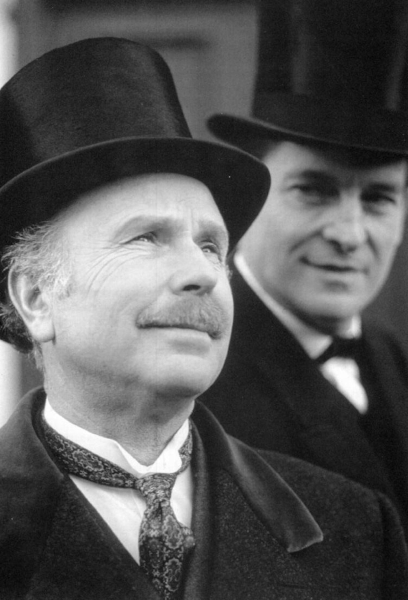
Much of this post is taken from a May 1993 article: “THE CASE OF EDWARD HARDWICKE,” by Kate Tyndall for The Washington Post.
MANCHESTER, ENGLAND —
Well, I think he’s the audience. I think he is the, sort of, receptor of the idea. I think Watson really is every-man and one has to remind oneself that he’s working with, or associating with, a genius.”
Edward Hardwicke plays public television’s serene and collected Dr. John Watson to Jeremy Brett’s mercurial, neurotic, and brilliant master detective Sherlock Holmes.
Hardwicke, 60, talked about his role as Dr. Watson, the new, two-hour format Granada Television has chosen in producing the Arthur Conan Doyle stories and the fate of the series in the wake of a changing of the guard at the studio.
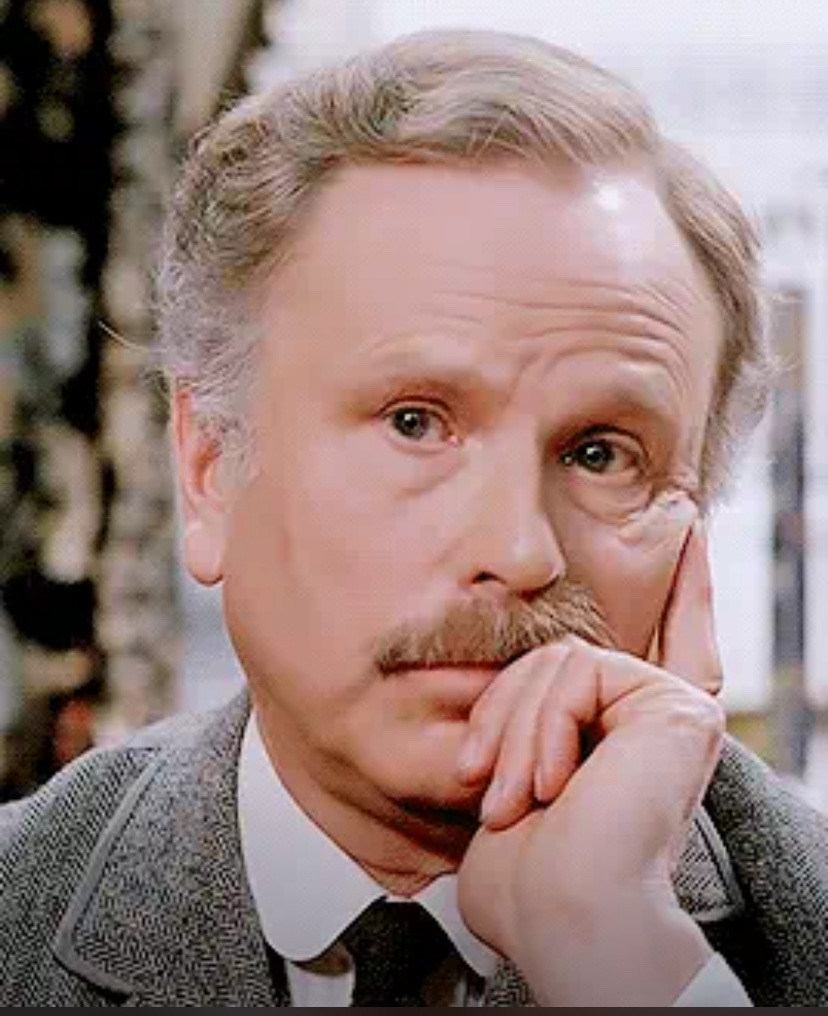
“To me, the Sherlock Holmes stories are about a great friendship. Without Watson, Holmes might well have burnt out on cocaine long ago. I hope the series shows how important friendship is.” Jeremy Brett.
As the child of two actors, Sir Cedric Hardwicke and Helena Pickard, it must have seemed that his son was “doomed to be an actor,” as the elder Hardwicke wrote in his 1961 autobiography, “A Victorian in Orbit.” Sir Cedric (knighted in 1934), a character actor who spent many years off and on in Hollywood during the ’30s and ’40s with his young family, appeared in countless films and interpreted many of playwright George Bernard Shaw’s great works on stage. In the Birthday Book that the father started for his young son, Cedric prevailed upon those he called “men reputed to be the wisest of our time” to write words of advice to his son. It is a tradition the actor has kept up for his daughters. Shaw wrote: “Don’t go on the stage, Edward. You would only be Cedric Hardwicke’s son at best; and it’s a precarious profession anyhow.” Hardwicke has been acting for the last 40 years on stage, film, television and radio.
Like Watson, Ted Hardwicke, as he is usually called, is charming, affable and a good companion. He’s also a natty dresser. This evening he is wearing black and white hound’s-tooth jacket, a puff of red silk issuing from the breast pocket, with a blue denim work shirt and casual slacks. As well done and likable as his Watson is, it’s Hardwicke you want to take home.
The fictional character and the actor share the same passions: food and women. He indulges himself with the gustatory delights of Norman cuisine at his second home in France whenever he is not working, and he has four women of his own: his companion of 12 years, actress Prim Cotton; his two daughters, Kate, 30, and Emma, 27, from his first marriage; and Cotton’s 18-year-old daughter, Claire. He calls Cotton his wife, then explains, “We’re actually not married, but I call her my wife.” So why aren’t they married? “Why aren’t we married?” He laughs. “I don’t really know why. I expect we’ll probably get around to it.”
(The PBS Mystery! series was about to air the brilliant second installment of “The Master Blackmailer.” Granada was in the process of shooting the “The Eligible Bachelor,” when this interview took place.)
Cotton smokes, Hardwicke doesn’t, but used to and tolerates it well, which is a good thing, since he works with a four-pack-a-day Sherlock Holmes. Cotton collects stray cats, four currently, including “the second-largest cat in London,” which Hardwicke has learned to like and who reside at their house in North London. He can’t program VCRs, is afraid of scorpions and not overly fond of horses, and he describes his linguistic ability in French as high on willingness to chat, low on vocabulary, except in the special category of construction terms. The ongoing renovation of the house in Normandy has proven a real goad to improving his vocabulary in that area.
On the set the following afternoon, Hardwicke, in full Watsonian garb, is sitting in the trailer with daughter Emma, a petite blonde and a former dancer and aspiring actress who has come to Manchester from London to hang out with dad for a day, and actor Bob Sessions.
Sessions, an American who has lived in England for many years, is playing the heroine’s father in the story being filmed, an adaptation of “The Noble Bachelor.” The title raises a separate question: Will Watson, that perennial ladies’ man, ever get any romance in Granada’s adaptations? After all, Conan Doyle married him off several times. Hardwicke is rather vexed by Watson’s celibacy.
“Unfortunately, I don’t think I do get any romance,” he said. “I think I’ve got rather past it now. Sadly, I’m seen as sort of paternal.”
With the wrap of this latest film, Hardwicke will have completed 15 episodes in the Sherlock Holmes canon. His predecessor in the role, David Burke, appeared in 13. Burke is credited with breathing new life into Watson by playing him as his author wrote him — as a contemporary of Holmes, a competent physician, an intelligent man, a loyal friend, rather than the inept bumbler as Watson is often portrayed on film.
When Burke decided to leave the series to join the Royal Shakespeare Company for a season with his wife, actress Anna Calder-Marshall, he encouraged Hardwicke, a friend, to apply for the role. “He said, ‘You must do it; you must get your agent onto it,’ and he rang Jeremy.” Hardwicke did as Burke suggested and won the role. He knew Brett from the National Theatre Company, where both were members in the late 1960s and early ’70s, but the two had never appeared in a production together.
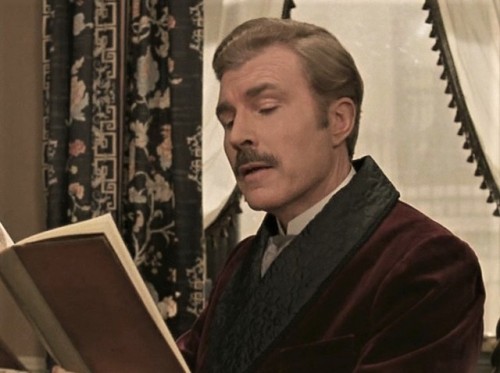
“I remember David saying, ‘Y’know, you’re going to have days and days and days when you stand around and say, ‘I don’t know, Holmes’ or ‘Yes, Holmes,’ or lift your eyebrow.’ And that does happen now, but it’s not quite like it was earlier in the series.”
Hardwicke makes an altogether different Watson from Burke’s, but one just as engaging. His doctor is less perky than Burke’s, a little more sophisticated and soldierly, as befitting a character who served in the Afghan war attached to the Fifth Northumberland Fusiliers. But this Watson is not without humor, and in some of the more recent episodes is apt to call Holmes on his more outrageous behavior. Hardwicke’s performance is beautifully nuanced, but as he said, deliberately underplayed to point up the contrasts between the two men.
“People have kindly talked about the good chemistry between Jeremy and I, and I would be hard put to know what this is,” he said. He is deprecating what he has brought to the character of John Watson. It turns out that it is Edward Hardwicke.
“I think the trouble with a lot of acting in England in a way is that there is too much acting in it. In a sense, you have to say, well, they have seen something in me that they think would be suitable for the part, so one has got to try to get as close to you as you can,” he said.
He had definite ideas about the relationship between the two men. “You’re talking about a period when women, I think, were put on pedestals, so it wasn’t possible for men to have friendships with women. Therefore, men had friendships with each other of a kind that I don’t think exists today.
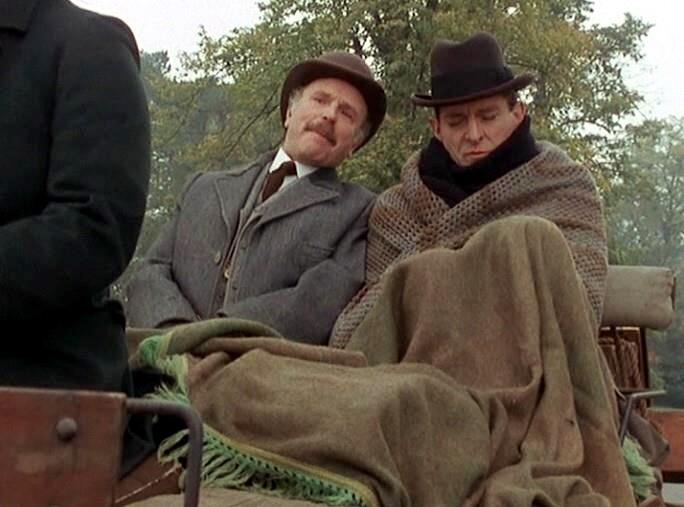
“The other thing is a sense of humor. And I came to this in a negative way,” Hardwicke said, “because when you look at the stories and suddenly Watson says, ‘Good heavens, Holmes,’ if he says it in a kind of pompous, stupid way, it becomes boring. But if it’s said with a slight smile, a slightly appreciative kind of thing, then it becomes something different. So I felt the only way I was going to manage this was to have a sense of, not indulgence, that would patronize Holmes, but a sort of humour between us.
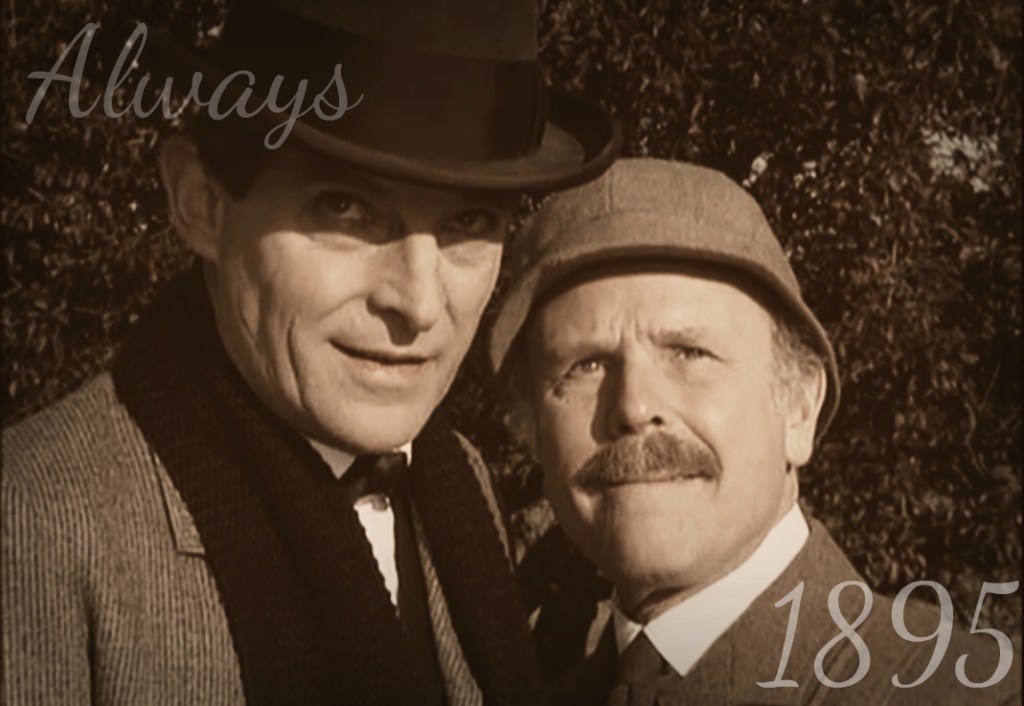
“I was very nervous about taking over the role because I’d watched the films without any thought of taking over the character and thought how good they were,” he said. After seven years of playing Watson to Brett’s Holmes both on the series and for 15 months in the West End and on tour with the play, “The Secret of Sherlock Holmes,” Hardwicke said: “I think Jeremy and I now trust each other. He knows what I’m doing and I know what he’s doing. Even though we may have disagreements, which we do, fundamentally I know and I marvel at the things he does.”
Hardwicke admires the format of the two-hour episodes but has a few reservations about some of the psychological elements that have crept into the most recent story adaptations, especially the current one, which has been renamed “The Eligible Bachelor.” “It’s a bit odd, a bit rich,” he said.
Comment from GA: For the first time in the history of this superbly crafted Sherlock Holmes series, the director of “The Eligible Bachelor” muddied the show’s excellence by showing an enmity for Doyle’s beloved characters, and failed utterly in his interpretation of the story.
“I think Jeremy finds it very scary, now that we have moved away from the straight adaptations. One of the things he’s marvellous at is dragging the lines back to Conan Doyle. Every time a line has been changed, he’ll say, ‘Why have you changed that? Why can’t we say what Conan Doyle wrote?’ I think Jeremy feels a bit as if the anchor has been pulled out from under.”
“The curious thing is, Watson doesn’t exist, really, in that he is writing the stories. So the only way he exists is in the way Holmes talks about him,” Hardwicke said. “Holmes, in a sense, distorts Watson.” So, to find the man that the great detective obviously admires, but also likes to take the mickey out of, Hardwicke says he plays the opposite of the distorted man Holmes describes. It works.
“Edward Hardwicke. He is one of the loveliest people, and I suppose he is the best friend that any man has ever had….in life. Which is after all how Doyle describes Watson.” Jeremy Brett.
Gretchen Altabef is an award-winning author of new Sherlock Holmes stories. The original Victorian cozy mysteries. THESE SCATTERED HOUSES brings Holmes to New York during his ‘great hiatus’. REMARKABLE POWER OF STIMULUS follows in London. During the investigation of a gruesome murder, Sherlock seizes a second chance with the woman, and they marry in anarchist-ridden Paris. The trilogy continues with FIVE MILES OF COUNTRY. Holmes is called in by Thomas Edison to solve a murder in his premier film studio, and Mrs Irene Adler-Holmes triumphs on Broadway. THE KEYS OF DEATH is a genesis story of 221B Baker Street and its inhabitants, as told by Mrs Hudson. Sherlock Holmes FAR & WIDE, nine stories and one play, including, “Sir Arthur and the Time Machine”.

 Features of Interest