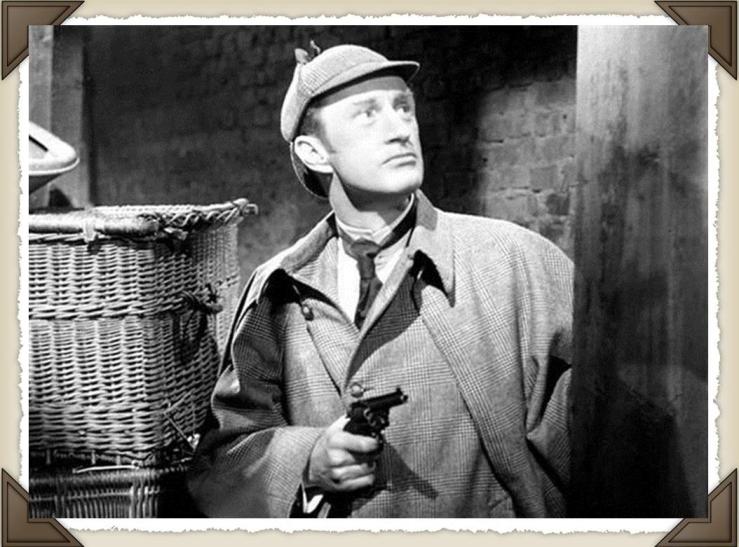
“Holmes is not an infallible, eagle-eyed, out-of-the-ordinary personality, but an exceptionally sincere young man trying to get ahead in his profession.” In my interpretation he, “has a more ascetic quality, is deliberate, very definitely unbohemian, and is underplayed for reality.” Ronald Howard.
Ronald Howard, was 36 when he was chosen to portray Sherlock Holmes. Howard shared his producer Sheldon Reynolds’s view of Holmes as a friendly, inquisitive gentleman who was comfortable with his genius. “Sherlock Holmes” (1954 TV series) was filmed in France by Guild Films in 39 half hour films. To me, what Howard created is one of the most realistic portrayals of a young Sherlock Holmes. He presents Holmes as a man we would want to know, who wears his talent and abilities lightly and convincingly. Because of his approach we accept Holmes as a real person, who can laugh at the absurdities of life and treat his clients with dignity and compassion.
Reynolds presented the Holmes of A Study in Scarlet, “I was suddenly struck by the difference between the character in that book and that of the stage and screen. Here, Holmes was a young man in his thirties, human, gifted, and of a philosophic and scholastic bent, but subject to fateful mistakes which stemmed from his over eagerness and lack of experience… In early stories like that one [Scarlet], Conan Doyle had not yet grown tired of his character, who later became a literary monster for him and, as literature, the earlier stories are far better. But practically every stage and screen presentation of the detective is based on the later stories.”
H. Marion Crawford, as Watson, put it this way, “I had never thought of Watson as the perennial brainless bungler who provided burlesque relief in the earlier portrayals. He is a normal man, solid on his feet, a medical student who gives valuable advice…. In other words, he is a perfect foil to Holmes’ youthful buoyancy.”
This “Sherlock Holmes” Series was my introduction to Sherlock. I was six-years-old and needless to say, Ronald Howard’s portrayal made an impression on me. My murder-mystery-loving mom and I watched on our 16” black and white TV. I was fascinated by this genial, gentleman Holmes who shared the tube with my favorite cowboys. This mysterious place and time, 19th-Century London, England, with its danger, fog, and flickering gaslight captured my young New Yorker’s imagination. The stories were not the same old plot, all shoot-‘em up’s and chasing bad guys on horseback through the dusty Los Angeles desert. But, a young, astute, and friendly gentleman who worked out each crime to its solution using only his quick mind and creative intuition. And with his stalwart friend, the courage to face what may.
In the Nifty Fifties, out-of-necessity, girls with imagination learned to transpose gender, and we frequently imagined ourselves as the heroine’s and the more prevalent heroes of the day. Yet I was young for this to springboard me to the stories. I read Conan Doyle concurrently with Poe, in High School. Not as required reading in a Catholic Girls School! But as contraband concealed beneath the dust jacket of something deemed appropriate for a young lady. Poe taught me to write. Doyle awakened my imagination. The good sisters taught me the necessity of red-herrings. And the traveling troupe of actors who presented Shakespeare’s plays in the sanctuary of our gym, with only their acting ability, and the Bard. Like Poe and Doyle this generated another explosion in my writer’s mind, imagination, and my love for the English language.
Arthur Conan Doyle brought me through the magic door, as he intended to do. Like so many who call ourselves Sherlockians and Holmesians, his world fascinated me. Yet like mine, it spoke of crime, horror, poverty and injustice. That he took on the actual horrors of my day: the KKK, women’s lack of freedom in marriage, divorce, classism, poverty, women who bravely faced life challenges, the Mafia, blackmailers, the abuse of alcohol and it’s usually violent consequences, and kidnaping, spoke to a girl growing up in 1950s pre-feminist atomic age. Through the justice-focused heroic genius of Sherlock Holmes I acknowledged my own intelligence, imagination, and talent at a time when girls with ideas were told to be quiet.
Conan Doyle’s exceptional ability to create strong, impossible to ignore, characters gave us the unique but believable Mr. Holmes. He even created the first side-kick as a means to continually build the image of the great detective. Of course, Dr. Watson is a powerful figure in his own right. The idea of carrying their friendship through a series of singular yet distinct stories was also Doyle’s. Every TV, film, radio, internet, book and game series, owes a debt of gratitude to him for this format.
I recommend a reading of his autobiography Memories and Adventures along with his Holmes canon. I have found it a loyal and uncommon companion in the writer’s process, every paragraph full of Arthur Conan Doyle’s personality, inspiration, and humour. After all, Holmes was not only inspired by Conan Doyle’s friendship with Dr. Joseph Bell and Mr. Oscar Wilde, but from the mind of the man who, Dr. Bell said, really was Sherlock Holmes.
Gretchen Altabef is an award-winning author of new Sherlock Holmes stories. The original Victorian cozy mysteries. THESE SCATTERED HOUSES brings Holmes to New York during his ‘great hiatus’. REMARKABLE POWER OF STIMULUS follows in London. During the investigation of a gruesome murder, Sherlock seizes a second chance with the woman, and they marry in anarchist-ridden Paris. The trilogy continues with FIVE MILES OF COUNTRY. Holmes is called in by Thomas Edison to solve a murder in his premier film studio, and Mrs Irene Adler-Holmes triumphs on Broadway. THE KEYS OF DEATH is a genesis story of 221B Baker Street and its inhabitants, as told by Mrs Hudson. Sherlock Holmes FAR & WIDE, nine stories and one play, including the award-winning, “Sir Arthur and the Time Machine”.

 Features of Interest